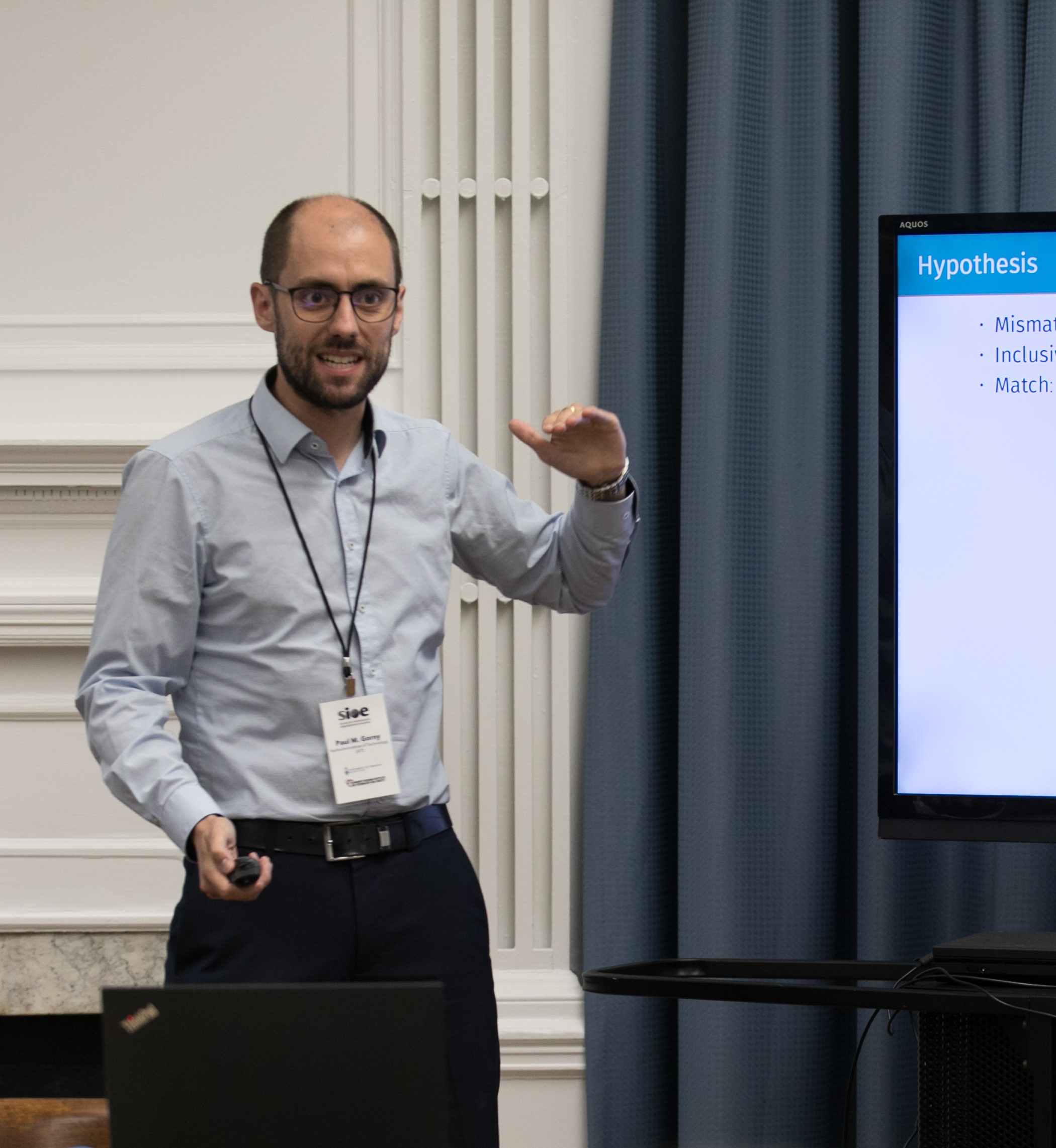
I am a behavioral and experimental economist whose work examines how both gendered language and emerging technologies shape economic behaviour and human interaction. In my job market paper I study how gender embedded in job advertisements influences perceptions and decisions surrounding hiring and applications. Another research stream investigates how the presence of artificial intelligence and robots reshapes human behaviour—particularly within human–human interaction and team collaboration settings.
My research relies primarily on laboratory and field experiments as well as randomized controlled trials, and I complement these with projects using administrative, platform, and textual data. I am strongly committed to methodological innovation, integrating tools such as eye-tracking, biosensors, and advanced computational methods to deepen behavioural insights.
During my PhD, I worked on Contest Theory and Networks with a particular focus on studies that apply to Conflict, Identity and asymmetries in skills, prize valuations, and costs.
by Fišar, M., Greiner, B., Huber, C., Katok, E., Ozkes, A., and the Management Science Reproducibility Collaboration · Management Science, 70(3), pp. 1343–2022, 2024
Contributed as a Member of the Management Science Reproducibility Collaboration.
@article{fisar2024reproducibility,
  author  = {Fi{\v s}ar, Milo{\v s} and Greiner, Ben and Huber, Christoph and Katok, Elena and Ozkes, Ali and {Management Science Reproducibility Collaboration}},
  title   = {Reproducibility in Management Science},
  journal = {Management Science},
  volume  = {70},
  number  = {3},
  year    = {2024},
  doi     = {10.1287/mnsc.2023.03556}
}
joint with Benedikt Renner and Louis Schäfer · Frontiers in Behavioral Economics, 2, 1220563, 2023 · preregistration
@article{gorny2023prosocial,
  author  = {Gorny, Paul M. and Renner, Benedikt and Sch{\"a}fer, Louis},
  title   = {Prosocial Behavior Among Human Workers in Robot-Augmented Production Teams---A Field-in-the-Lab Experiment},
  journal = {Frontiers in Behavioral Economics},
  volume  = {2},
  pages   = {1220563},
  year    = {2023},
  doi     = {10.3389/frbhe.2023.1220563}
}
joint with Christoph Huber, Anna Dreber, Jürgen Huber, Magnus Johannesson, Michael Kirchler, Utz Weitzel, Felix Holzmeister and others · PNAS, 120(23), e2215572120, 2023
@article{huber2023competition,
  author  = {Huber, Christoph and Dreber, Anna and Huber, J{\"u}rgen and Johannesson, Magnus and Kirchler, Michael and Weitzel, Utz and Holzmeister, Felix and Gorny, Paul M. and others},
  title   = {Competition and Moral Behavior: A Meta-Analysis of Forty-Five Crowd-Sourced Experimental Designs},
  journal = {Proceedings of the National Academy of Sciences},
  volume  = {120},
  number  = {23},
  pages   = {e2215572120},
  year    = {2023},
  doi     = {10.1073/pnas.2215572120}
}
@unpublished{gorny2026gender,
  author = {Gorny, Paul M. and Nieken, Petra and Trenkle, Martin},
  title  = {The Gender of Opportunity: How Gendered Job Titles Affect Job Seeker Attraction},
  note   = {Working paper},
  year   = {2026}
}
Language carries information. In labor markets, even minimal linguistic cues in job ads can function as signals that update job seekers’ beliefs about organizational culture and thereby shape application behavior. We study this mechanism using three complementary datasets. In a large-scale field experiment on a major German job platform, switching job titles from the generic masculine to a gender-fair form increases female applications in Business & Management by roughly 50%, with no decline in male applications. This effect is mirrored by a significant increase in female clicks, indicating that the signal operates already at the stage of initial consideration. Effects are absent in Marketing & Sales and in IT & Development overall, but emerge for IT positions posted by non-IT firms–consistent with a belief-updating mechanism that requires sufficiently elastic priors. An online study with hiring experts shows that gender-fair title usage is driven more by genuine support for gender equality than by strategic motives, suggesting that the titles are credible signals of employer type. A laboratory eye-tracking experiment with job seekers confirms that the behavioral response reflects belief-based evaluation rather than automatic visual salience. Together, the evidence demonstrates that language operates as a market signal in recruitment: a virtually costless three-character change can meaningfully expand the applicant pool when prior beliefs have room for updating.
joint with Louis Schäfer
· R&R at Experimental Economics
We study human-robot collaboration in a controlled experiment run in a realistic production environment. Participants completed a sequential task in pairs, where one worker decided whether to pass intermediate components to a coworker or not. We find strong evidence of robot aversion: workers were significantly less likely to pass intermediate products in the robotic treatments. Adaptivity only marginally affected these outcomes. Our results demonstrate that cooperation and responsibility attribution in hybrid teams depend not only on performance but also on social perceptions of artificial agents.
joint with Eva Groos and Christina Strobel
· R&R at Journal of Behavioral and Experimental Economics
We study how personalized AI predictions affect individual choices in the context of altruistic decisions. Using data from dictator games, we trained an AI tool to generate personalized predictions of dictators' choices. We find that participants sent less when they received predictions, with the strongest reduction when a human overseer withheld the prediction. These findings highlight the need to consider human reactions to AI predictions when assessing both the accuracy and impact of such tools.
Gendered Language, Economic Behavior, and Norm Compliance
joint with Petra Nieken and Karoline Ströhlein
· submitted, draft available upon request
We conducted a controlled experiment to examine how the gender frame of instructions—male, female, or gender-inclusive—along with norm salience influences norm compliance. We find a statistically significant negative effect of the gender-inclusive frame on norm compliance for almost all participants and a negative effect of the male gender frame on men's norm compliance. These findings contribute to the debate on gender-inclusive language by highlighting its unintended behavioral effects.
Firms increasingly rely on digital technologies that generate real-time data, raising the question of how information should be provided to workers. We study how the timing and discretion of information provision affect productivity in a field-in-the-lab experiment conducted in a learning factory that mirrors key features of modern manufacturing environments. Participants perform a multitasking real-effort task assembling two product variants and decide when to retool a machine. We compare whether operational information is unavailable (Baseline), automatically pushed (Push), or pulled on demand (Pull). Information provision affects intertemporal coordination, particularly variant-switch timing. Pull increases output for infrequent switchers but reduces output for frequent switchers. Overall, conditional on switching, Pull outperforms Baseline, while Push yields no productivity gains. Our findings highlight a trade-off: discretion over information timing can facilitate strategic coordination but may reduce performance under frequent task switching.
We analyse the correlation between job satisfaction and automatability. Using multiple survey datasets matched with various measures of automatability, we find a negative and statistically significant correlation that is robust to controlling for worker and job characteristics. We provide evidence that monotonicity and low perceived meaning of the job drive both automatability and low job satisfaction.
Across appointments in Germany and the UK, I have taught undergraduate and postgraduate courses in economics, labor markets, organizations, and international development.
LecturerKarlsruhe Institute of TechnologyApr 2024 – Sep 2024Personnel Policy and Labor Market Institutions (Bachelor) and Incentives in Organizations (Master)
Teaching AssistantKarlsruhe Institute of TechnologySep 2019 – presentSupervision of 30 Bachelor and 14 Master theses; interdisciplinary Engineering, Information Systems, and Economics team projects (Bachelor); tutorials in Personnel Policy and Labor Market Institutions (Bachelor) and Incentives in Organizations (Master)
Teacher for EconomicsINTO University of East Anglia, NorwichJan 2019 – Aug 2019Introductory Macroeconomics and Core Economics for Bachelor and Master students
Teaching AssistantUniversity of East Anglia, NorwichSep 2016 – Apr 2019Seminar leader for Introductory Macroeconomics (Undergraduate)
Student AssistantUniversity of Cologne, CologneApr 2013 – Jul 2015Tutor for Introductory Microeconomics and Introductory Macroeconomics (Undergraduate)
Curriculum Vitae
A full version of my CV is available for download.